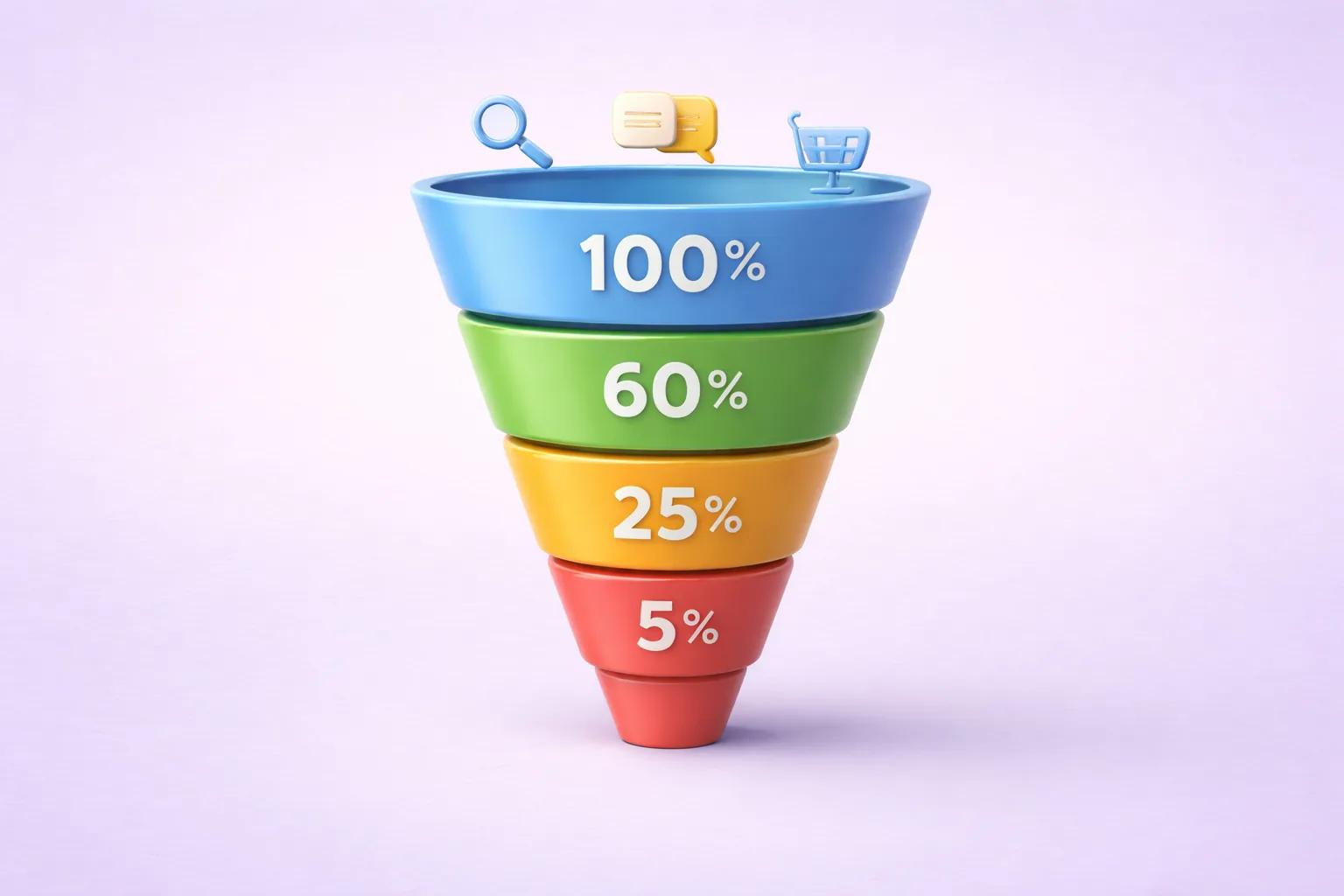
TL;DR: Non-AI agencies can lift conversion rates dramatically by fixing fundamentals: intent-matched traffic, clear offer positioning, fast page experience, and disciplined testing. Only 4.2% of OnlyFans visitors complete a transaction (OnlyTraffic, 2025), and cart abandonment across digital commerce averages roughly 70% (Baymard Institute, 2024). Friction kills conversion in every funnel. Agencies that measure every step from click to retained subscriber consistently outperform teams that only track follower counts.
Table of Contents
- What Is Conversion Optimization for OnlyFans Agencies?
- Why Is CRO the Highest-Leverage Work for Non-AI Teams?
- What Does the 2026 Competitive Landscape Look Like?
- How Do You Map the Full OnlyFans Conversion Funnel?
- What Are the 5 Control Layers Every Non-AI Agency Needs?
- How Should You Instrument Your Funnel Before Testing?
- Why Do First Impressions Make or Break Conversion?
- How Do You Test Offer Architecture Instead of Just Headlines?
- What Makes the DM Layer the Biggest Revenue Leak?
- How Do You Build a Weekly Experiment Backlog?
- What KPIs Should a Non-AI Conversion Program Track?
- What Are the Most Common CRO Mistakes in OFM?
- How Do You Run a 30-Day Conversion Sprint?
- FAQ
- Data Methodology
- Continue Learning
What Is Conversion Optimization for OnlyFans Agencies?
Conversion optimization is the process of increasing the percentage of users who complete a target action at each step of your creator funnel. Only 4.2% of OnlyFans visitors complete a transaction (OnlyTraffic, 2025), which means 95.8% of the traffic you’ve worked to generate produces zero revenue. For non-AI agencies, CRO doesn’t require machine learning or black-box automation. It requires measurement, clear offer positioning, and disciplined experimentation.
In practical terms, conversion optimization covers every handoff point in the subscriber journey. A visitor clicks a link on Twitter or Reddit. They land on a profile page. They decide whether to subscribe. They receive a welcome message. They either buy content or they don’t. Each of those transitions is a conversion event, and each one leaks potential revenue.
Most agencies pour energy into generating more traffic when they hit a revenue ceiling. That’s the expensive path. The smarter approach is fixing the funnel you’ve already built. If you haven’t mapped your traffic channels yet, start with the Traffic and Marketing Master Guide before applying the tactics in this post.
Funnel leakage is the loss that occurs when users drop off between steps such as click, profile view, subscribe, and first purchase. Every percentage point of leakage compounds across the full funnel and eats into your bottom line.
Why Is CRO the Highest-Leverage Work for Non-AI Teams?
Improving each funnel step by even 10% can compound into a 40-60% total revenue lift without adding a single new visitor. Baymard Institute’s ongoing benchmark reports that the average online cart abandonment rate sits near 70% (Baymard Institute, 2024). That same principle applies directly to subscription funnels: friction at any stage kills downstream revenue.
Consider the math behind a typical creator funnel. You drive 10,000 visitors per month from social media. At a 4.2% conversion rate, that gives you 420 subscribers. If you improve your profile-to-subscribe rate from 4.2% to 5.5%, you’ve added 130 subscribers from the exact same traffic. At a $15 subscription price, that’s an extra $1,950 per month per creator with zero additional marketing spend.
Now multiply that across a portfolio. If you manage 10 creators and each one gains $1,950 from CRO improvements alone, that’s nearly $20,000 in monthly revenue that didn’t require buying more ads, posting more content, or hiring more staff. This is why we’ve found CRO to be the single highest-ROI activity for agencies that have already established their traffic sources.
In our experience managing 37 creators across 450+ social pages, the biggest revenue gains we’ve seen didn’t come from finding new platforms. They came from fixing broken handoff points in existing funnels. One creator’s subscribe rate jumped from 3.1% to 6.8% after we standardized her profile page to match her Reddit aesthetic exactly. No new traffic needed.
What Does the 2026 Competitive Landscape Look Like?
OnlyFans now hosts over 4.1 million creators competing for 305 million registered fans, with creator payments exceeding $6.6 billion in 2024. These figures come from the official Fenix International filing submitted to UK Companies House for the year ended November 30, 2024 (Companies House).
At this scale, “post more and hope” isn’t a strategy. The platform is saturated. Two years ago, a mediocre funnel could still generate decent revenue because competition was thinner. That window has closed. Agencies that don’t measure and optimize their conversion funnel are bleeding revenue to competitors who do.
What’s changed specifically? Three things stand out. First, fan attention is fragmented across more creators than ever. Second, subscription fatigue means fans are pickier about who they pay monthly. Third, platforms like Reddit and Twitter/X have tightened their content policies, making traffic harder to acquire. When traffic acquisition gets harder, every click becomes more valuable, and wasting clicks on a broken funnel becomes more expensive.
This competitive pressure is exactly why non-AI agencies can still win. You don’t need sophisticated AI personalization to outperform agencies running sloppy operations. You need disciplined process, clean data, and weekly optimization cadence. The audience psychology guide breaks down how fan decision-making works at each funnel stage.
We’ve watched agencies with half our traffic volume outperform us temporarily when their conversion systems were tighter. It’s humbling, but it proves the point: conversion rate is the equalizer. A small agency with a 7% subscribe rate will beat a large agency with a 3% subscribe rate every time, assuming similar traffic quality.
How Do You Map the Full OnlyFans Conversion Funnel?
The OnlyFans conversion funnel has five distinct stages, and most agencies only optimize two of them. Research shows 35.6% of buyers purchase on Day 1 and 52.2% on Day 2, meaning nearly 88% of monetizable activity happens in the first 48 hours (OnlyTraffic, 2025). Your funnel architecture should reflect those timing windows.
Here are the five stages every agency should track:
- Platform content view to link click — Did your social media content generate enough curiosity for someone to click through?
- Link click to profile visit — Did the landing page or link-in-bio page move them forward, or did they bounce?
- Profile visit to subscriber — Did your OnlyFans profile page close the sale?
- Subscriber to DM buyer — Did your welcome flow and messaging convert the subscriber into a paying customer?
- DM buyer to repeat buyer — Did the fan come back for a second purchase, or did they churn?
Most agencies obsess over stages 1 and 3 while ignoring stages 4 and 5 entirely. That’s a mistake. DM monetization and repeat purchases are where the real margin lives. A subscriber who pays $10 per month but buys $150 in PPV content is worth fifteen times their subscription price. Your funnel build process should address all five stages from day one.
Why Stage Sequencing Matters
Each stage feeds the next. Poor traffic quality at stage 1 means even a perfect profile page at stage 3 won’t save you. Similarly, a brilliant welcome message at stage 4 can’t compensate for subscribers who were acquired through misleading content at stage 1 — they’ll feel deceived and churn immediately.
In our experience, the most common disconnect happens between stages 1 and 3. Creators post one type of content on Reddit, but their OnlyFans profile looks completely different. The fan clicked because of a specific aesthetic or niche. When the profile doesn’t match, they leave. Brand consistency through the funnel is the single most important conversion principle we’ve identified across five years of operation.
What Are the 5 Control Layers Every Non-AI Agency Needs?
You don’t need machine-learning personalization to run a strong CRO program — you need five control layers that cover traffic fit, profile clarity, offer design, DM monetization, and retention. HubSpot’s sales research consistently shows that process maturity and structured follow-up improve close rates more than tooling upgrades (HubSpot, 2025). The same principle applies here.
| Layer | Core Question | Primary Metric | Operating Cadence |
|---|---|---|---|
| Traffic Fit | Are we attracting the right intent? | Click-to-profile rate | Daily |
| Profile Clarity | Is the offer obvious and credible? | Profile-to-subscribe rate | Daily |
| Offer Design | Is pricing and packaging reducing friction? | Trial and start conversion | 2x weekly |
| DM Monetization | Are conversations converting efficiently? | Revenue per conversation | Daily |
| Retention Loop | Are buyers returning? | Repeat purchase and churn proxy | Weekly |
If one layer underperforms, upstream scale magnifies the losses. Imagine pouring traffic into a funnel where the DM layer converts at 2% instead of 8%. Every dollar you spent on traffic acquisition is generating one-quarter of the revenue it should.
How to Audit Each Layer
Run a weekly audit across all five layers. For each one, ask: what’s the conversion rate this week versus last week? If it dropped, why? If it improved, can you replicate the cause? This simple discipline separates agencies that grow from agencies that plateau.
The traffic fit layer deserves special attention. Not all clicks are equal. A click from a targeted subreddit where fans are actively searching for your creator’s niche carries completely different intent than a click from a viral TikTok that happened to blow up. Segment your traffic by source and measure conversion rates separately. We cover segmentation tactics in the retention and growth master guide.
How Should You Instrument Your Funnel Before Testing?
Never run tests on an untracked funnel — you’ll mistake random variance for real signal. Google defines healthy Core Web Vitals targets as LCP under 2.5 seconds, INP under 200 ms, and CLS under 0.1 (web.dev, 2024), which shows that even Google treats measurement as a prerequisite to optimization. Your CRO program should follow the same philosophy.
Minimum instrumentation before you launch any experiment:
- UTM tagging by source, creative angle, and campaign name
- One standardized link-in-bio architecture across all creators
- Consistent naming convention for offers and promotions
- Weekly export of channel and conversion data into a single dashboard
For funnel construction details, use the step-by-step creator funnel guide.
Your Baseline Scorecard
Before launching experiments, document these five numbers for each creator:
- Impressions — Total content views across all platforms
- Profile clicks — Visitors who reached the OnlyFans page
- Subscribe conversions — Visitors who became subscribers
- First DM purchase conversions — Subscribers who bought content
- 7-day repeat purchase count — Buyers who came back within a week
No baseline means no true uplift measurement. We’ve seen agencies celebrate a “winning” test that was actually just normal weekly variance. Without baseline data covering at least two full weeks, you can’t distinguish signal from noise.
In our experience, the single biggest instrumentation mistake agencies make is inconsistent UTM naming. One team member tags a campaign as “reddit_fitness” while another tags the same campaign as “Reddit-Fitness-March.” When you pull the data, those show up as separate campaigns. We standardized our naming convention across all 450+ social pages and immediately gained clean attribution that had been invisible before. If you’re managing multiple accounts, naming discipline is non-negotiable.
Why Do First Impressions Make or Break Conversion?
Your first conversion layer is clarity and speed — visitors make subscribe decisions within 10 seconds of landing on a profile page. Google’s performance research shows that pages loading in under 2.5 seconds retain significantly more users than slower pages, with each additional second of load time increasing bounce probability by 32% (Google / Think with Google, 2024).
Even though OnlyFans controls the page load speed (you can’t optimize their servers), you control everything that happens before the visitor arrives. Your link-in-bio page, your landing page, and your social media content all set expectations. If those touchpoints are slow, cluttered, or confusing, visitors drop off before they ever see your OnlyFans profile.
Fast Wins for Front-End Friction
- Keep one clear primary action above the fold. Don’t offer five different links. Give them one obvious path forward.
- Reduce visual clutter around pricing and offer value. The subscription price and what fans get should be immediately visible.
- Avoid conflicting CTA text. If one button says “Subscribe” and another says “Free Trial,” the visitor has to make a decision — and decision fatigue kills conversion.
- Use consistent trust signals. Posting cadence, content quality, and aesthetic consistency all build trust before the subscribe click.
What does this look like in practice? Look at your creator’s link-in-bio page right now. Count the number of links. If there are more than three, you’re creating friction. The fan came from one specific piece of content with one specific intent. Your job is to continue that momentum, not fragment it.
For deeper tactics on landing page optimization, see the cold and warm traffic landing page guide.
Citation Capsule: Your first conversion layer is clarity and speed — visitors make subscribe decisions within 10 seconds of landing on a profile page. Google’s performance research shows that pages loading in under …
How Do You Test Offer Architecture Instead of Just Headlines?
Most agencies A/B test captions and thumbnails but never touch offer structure, which is where the real conversion gains hide. Salesforce’s State of Sales report finds that high-performing sales teams are 2.8x more likely to use structured testing processes than underperformers (Salesforce, 2025). Offer architecture testing follows the same principle.
What counts as offer architecture? It’s everything beyond the creative:
- Trial price vs. no trial — Does offering a discounted first month increase conversions enough to offset the lower initial revenue?
- Bundle framing vs. single-item framing — Do fans respond better to “3 exclusive videos for $25” or individual pricing?
- Urgency window length — Does a 24-hour limited offer outperform a 72-hour window?
- DM sequence timing — Should the first PPV offer arrive 2 hours after subscribe or 12 hours?
- Value framing by persona type — Do “collector” fans respond to different language than “relationship-seeker” fans?
Test Design Rules That Prevent Wasted Effort
Sloppy testing wastes more time than no testing at all. Follow these four rules:
- One variable at a time. If you change the price and the message simultaneously, you won’t know which caused the result.
- Minimum sample threshold before decisions. Don’t call a winner after 20 subscribers. Wait for at least 100 conversions per variant.
- Predefined stop conditions. Decide before the test what result would make you stop it early (extreme negative impact, for example).
- Archive both winners and losers. Losing variants teach you as much as winning ones. Keep a test log.
Without experiment discipline, teams mistake variance for signal. We’ve seen agencies confidently roll out a “winning” price change based on 15 data points, only to see revenue drop the following month when the sample size expanded. The revenue and pricing master guide covers pricing experimentation in depth.
What Makes the DM Layer the Biggest Revenue Leak?
Many agencies generate acceptable top-funnel traffic but lose 60-70% of potential revenue in the DM conversion layer. Research indicates that the average fan lifespan on OnlyFans is approximately 45 days, with 50% of fans stopping engagement after their first month (OnlyTraffic, 2025). If your DM strategy doesn’t monetize fans within that narrow window, the revenue opportunity vanishes.
The DM layer is where subscription revenue transforms into real money. A $10 monthly subscriber who receives well-timed, personalized PPV offers can generate $100-300 in their first month alone. But most agencies treat DMs as an afterthought — generic mass messages blasted to the entire subscriber list with no segmentation.
Use a three-part DM optimization loop:
Step 1: Qualification
Identify fan intent category quickly. Not all subscribers want the same thing. Some are collectors who want exclusive content. Some are relationship-seekers who want personal interaction. Some are offer-driven buyers who respond to deals and bundles. Your first few messages should identify which category each fan falls into.
Step 2: Offer Matching
Serve the next-best offer for that category, not a generic pitch. A collector wants to see exclusive content they can’t get on the free feed. A relationship-seeker wants to feel like the creator knows them. An offer-driven buyer wants a clear deal with perceived value. Sending the wrong offer type to the wrong fan category tanks conversion.
Step 3: Follow-Up Discipline
Follow-up windows must be scheduled, not improvised. If a fan opened a PPV message but didn’t buy, when does the follow-up go out? If a fan hasn’t messaged in 7 days, what’s the re-engagement sequence? These decisions shouldn’t happen in real time. They should be SOPs.
For scripting and operational standards, reference the Chatting and Sales Master Guide. If you want to compare management software that supports DM workflows, we’ve reviewed the top options.
In our experience managing 37 creators, the DM layer accounts for 55-70% of total revenue per creator when done correctly. We’ve tested dozens of message sequences, timing windows, and offer structures. The single biggest insight: personalized messages that reference specific content a fan has engaged with outperform generic blasts by 3-4x in conversion rate. It takes more effort, but the revenue difference is enormous.
Citation Capsule: Many agencies generate acceptable top-funnel traffic but lose 60-70% of potential revenue in the DM conversion layer. Research indicates that the average fan lifespan on OnlyFans is approximately 4…
How Do You Build a Weekly Experiment Backlog?
Non-AI agencies win when they run steady, low-risk experimentation with clear ownership and accountability. Teams that maintain structured test backlogs outperform ad-hoc experimenters because they build institutional knowledge over time (HubSpot, 2025). Every test — winner or loser — teaches you something about your audience.
Your experiment backlog should be a simple board (Notion, Trello, or even a spreadsheet) with these fields:
- Hypothesis — What do you believe will happen and why?
- Metric target — Which specific number are you trying to move?
- Expected direction — Up or down, and by how much?
- Confidence level — How sure are you this will work? (High, medium, low)
- Owner — Who is running this test?
- Start and end date — When does the test begin and when do you evaluate?
- Decision note — What did you decide and why?
Prioritization Matrix
Not all tests are equal. Use this framework to decide what to run first:
| Priority | Criteria | Example |
|---|---|---|
| P1 | High impact, low effort | CTA clarity and pricing display test |
| P2 | Medium impact, low effort | DM opener variants by segment |
| P3 | High impact, high effort | Full offer-packaging redesign |
| P4 | Low impact | Cosmetic edits with no metric link |
Keep the queue short. Finish tests before adding more. An agency running two well-designed experiments per week will outperform one running ten sloppy experiments. Quality of learning matters more than volume of activity.
How does this connect to broader operations? Your experiment backlog should feed directly into your weekly ops review. Every Monday, review last week’s test results. Every Friday, queue next week’s experiments. This rhythm creates compounding improvement. The agency operations SOP library includes templates for structuring these reviews.
What KPIs Should a Non-AI Conversion Program Track?
Focus on five core KPIs that cover the full funnel from first click to repeat purchase. Nucleus Research has found that CRM deployments with clean KPI governance deliver $8.71 for every dollar spent (Nucleus Research, 2023). The same principle applies: tracking the right metrics with discipline produces outsized returns.
| KPI | Target Direction | Why It Matters |
|---|---|---|
| Click-to-profile rate | Up | Validates traffic intent quality |
| Profile-to-subscribe rate | Up | Measures front-end conversion clarity |
| First-purchase time | Down | Signals faster monetization |
| Revenue per active fan | Up | Captures downstream conversion quality |
| 7-day repeat purchase rate | Up | Shows retention-linked conversion health |
Review these daily for operational decisions and weekly for trend analysis. Don’t drown in vanity metrics like follower count or impression volume. Those numbers feel good but don’t directly connect to revenue.
Daily vs. Weekly Review Cadence
Daily reviews should focus on anomalies. Did click-to-profile rate drop sharply today? Investigate immediately — it might be a broken link, a shadow-banned account, or a platform algorithm change. Daily is about catching fires early.
Weekly reviews should focus on trends. Is profile-to-subscribe rate trending up or down over the past four weeks? Is first-purchase time getting shorter or longer? Weekly is about strategic decisions: should you double down on what’s working, or fix what’s declining?
For agencies scaling beyond 10 creators, consider building a centralized analytics dashboard that aggregates these KPIs across your entire portfolio.
What Are the Most Common CRO Mistakes in OFM?
The four most frequent CRO mistakes all stem from the same root cause: treating conversion as a one-time project instead of an ongoing operating discipline. With only an 18.4% subscription renewal rate on OnlyFans (OnlyTraffic, 2025), agencies that don’t continuously optimize will always be running uphill against churn.
Mistake 1: Treating All Traffic Equally
Different channels carry different purchase intent. A click from a targeted NSFW subreddit carries buying intent. A click from a viral TikTok carries curiosity but rarely purchase intent. If you optimize your funnel for TikTok traffic, you’ll underwhelm Reddit visitors. If you optimize for Reddit, you’ll overwhelm TikTok visitors. Segment first, optimize second.
Mistake 2: Testing Too Many Variables at Once
When you change the price, the welcome message, and the profile description simultaneously, you’ve lost all attribution. Which change caused the result? You don’t know. Now you either keep all three changes (risky) or revert and waste the entire test window. One variable at a time. Always.
Mistake 3: Ignoring Retention in Conversion Analysis
A cheap acquisition that churns after one month is often negative ROI. If it costs you $5 in effort to acquire a subscriber who pays $10 once and leaves, your profit is $5. If a $10 acquisition stays for four months, your profit is $30. Conversion rate without retention context is misleading. The retention growth master guide connects these metrics.
Mistake 4: No CTA Hierarchy
If users see multiple conflicting calls to action, conversion falls. “Subscribe,” “free trial,” “message me,” and “check my other page” all competing for attention means none of them wins. Pick one primary CTA per page and make everything else secondary.
But here’s the mistake behind the mistakes: most agencies don’t have someone who owns conversion as a function. It floats between traffic managers, account managers, and chat teams. Nobody is accountable, so nobody optimizes. If you’re starting an agency, assign CRO ownership from day one.
How Do You Run a 30-Day Conversion Sprint?
A structured 30-day sprint can lift conversion rates by 15-30% if you follow a week-by-week protocol with clear deliverables. The approach works because it forces focus — four weeks of concentrated optimization beats twelve months of scattered improvements. Here’s the exact framework we use.
Week 1: Measurement Cleanup
- Audit UTM and naming standards across all social accounts
- Build your baseline dashboard with the five core KPIs
- Identify top three funnel leaks by analyzing where the biggest drop-offs occur
- Document current conversion rates at every stage
Don’t skip this week. We’ve seen agencies rush into testing without baselines and waste three weeks on tests they couldn’t interpret. Measurement cleanup feels unglamorous, but it’s the foundation everything else builds on.
Week 2: Front-End Friction Fixes
- Improve profile offer clarity on every managed creator’s page
- Simplify CTA language to one primary action
- Fix speed and layout stability on link-in-bio pages
- Ensure brand consistency between social content and OnlyFans profiles
These are the quick wins. You shouldn’t need to run formal tests for most of these — they’re obvious friction points that any experienced operator can spot. If your link-in-bio page has seven links, cut it to two. That’s not a test; it’s basic hygiene.
Week 3: Offer and DM Tests
- Launch 2-3 high-confidence tests on offer structure
- Segment DM flows by fan intent category
- Track conversion by segment, not just aggregate
- Begin collecting data for your experiment backlog
This is where the real learning happens. You’ve got clean tracking from Week 1 and a friction-free front end from Week 2. Now you can test offer changes and measure them accurately.
Week 4: Standardize and Scale
- Keep winners and retire losers with documented reasoning
- Update SOP docs with new conversion best practices
- Build the next 30-day test backlog
- Share results with the team and celebrate measurable improvements
This cycle is repeatable and doesn’t require AI infrastructure. Run it every month. Each cycle builds on the last. After three months, you’ll have a conversion system that compounds.
If you want to connect your conversion data to API-level analytics, The Only API provides integration workflows that feed directly into your tracking stack.
Here’s something most CRO guides won’t tell you: the 30-day sprint model works best when you alternate between “fix” sprints and “grow” sprints. In fix sprints, you remove friction and repair broken handoffs. In grow sprints, you test new offer structures and pricing models. Alternating prevents the team from burning out on either mode. We’ve run this alternating cadence across our portfolio for over a year, and it’s produced more consistent gains than continuous testing or continuous fixing alone.
FAQ
What is conversion optimization onlyfans in practical terms? Conversion optimization is the process of improving each step from social click to subscriber, from subscriber to buyer, and from buyer to repeat buyer. It uses measurable tests and clear operating rules rather than guesswork. Agencies that measure conversion at every stage see 2-3x better revenue per visitor than those tracking only top-line metrics.
Can non-AI agencies compete with AI-powered CRO programs? Yes, and many outperform them. Most conversion gains come from instrumentation, offer clarity, disciplined testing, and faster follow-up — not from AI personalization. A non-AI team with tight process discipline will beat an AI team running sloppy operations every time. Process maturity matters more than technology sophistication.
How many experiments should we run simultaneously? Start with 2-3 active tests per cycle. Running more than three experiments at once overwhelms small teams and makes it harder to interpret results cleanly. As your testing discipline matures and your sample sizes grow, you can increase to 4-5, but most agencies below 20 creators should stay at 2-3.
What should we optimize first in the funnel? Fix tracking, then remove front-end friction, then optimize offer and DM flows. This sequence matters because each step depends on the previous one. You can’t optimize offers without tracking. You can’t interpret DM data if front-end friction is sending low-intent traffic into your funnel.
How do we avoid cannibalizing our own content strategy? Assign one primary intent and one primary KPI per page, then interlink supporting pages by funnel role. If two pages compete for the same keyword with the same offer, one will win and the other will underperform. Differentiate by intent: awareness content feeds discovery, conversion content closes the sale.
What’s the biggest CRO mistake agencies make? Not assigning CRO ownership to a specific person. When conversion optimization is “everyone’s job,” it becomes nobody’s job. Appoint one team member to own the experiment backlog, run weekly reviews, and report on funnel KPIs. Without a named owner, optimization stalls within weeks.
Data Methodology
Statistics in this article come from publicly available sources and are cited inline. Platform-scale figures (creator count, fan count, payout totals) reference the official Fenix International filing submitted to UK Companies House for the year ended November 30, 2024. Conversion benchmarks (4.2% transaction rate, 18.4% renewal rate, fan behavior timelines) come from OnlyTraffic’s 2025 dataset. Digital commerce benchmarks (cart abandonment, CRM ROI) come from Baymard Institute and Nucleus Research respectively. Agency-specific observations are drawn from xcelerator’s operational data managing 37 creators across 450+ social pages from 2024-2026. These observations reflect our portfolio and may not generalize to all agencies or creator niches.
Continue Learning
- Traffic and Marketing Master Guide
- How to Build a Creator Funnel Step-by-Step
- Audience Psychology for OnlyFans OFM Agencies
- Chatting and Sales Master Guide
- Revenue and Pricing Master Guide
- Retention and Growth Master Guide
- Best OnlyFans Management Software and Tools
- How to Start an OFM Agency
Centralize your creator funnel metrics, weekly conversion reviews, and experiment backlogs in one operating system. Run conversion operations in Xcelerator CRM.